What to Put in a Cleaning Business Employee Handbook: The Exact Sections
I used to think being a good boss meant being kind. I was generous, I was flexible, I gave people the benefit of the doubt every single time. And people took advantage of it constantly.
I have had an employee quit on me the morning of a clean, then message me a month later asking for her job back. I have had more than ten people confirm they were coming to an interview and then just not show up. I had someone call me absolutely ridiculous for asking her to return my supplies after she quit, and I had given her a full month to do it. If I listed every bad experience I have had with an employee, we would be here for two hours.
What finally fixed it was not finding nicer people. It was realizing that being kind was not enough, and that I needed actual systems to keep my team and grow my business. The first and most important of those systems is the employee handbook. Here is exactly what goes in mine.
Who to call, and who runs what
The very first section is contact information: me, my general manager, and my training manager. It sounds almost too simple to write down, but when a cleaner is standing on a client’s porch and the key is not where it is supposed to be, you do not want her guessing who to text. Naming the roles also tells a new hire how the business is structured on day one, so she knows her trainer is a real position and not just whoever happens to answer first.
If you are a solo owner about to make your first hire, you are all three roles for now. Write that down too. The point is that nobody is ever unsure who to go to.
Who we are: mission, values, and culture
This is the section most owners skip because it feels corporate and soft. It is the one I would never cut.
I put our company culture, our values, and our mission statement right near the front, so that when employees come in they know exactly what we stand for. A cleaning job is a job someone can get in a dozen places. What makes a person stay is feeling like they are part of something with a standard. You cannot hold people to a standard you never told them about, and you cannot expect loyalty to a business whose reason for existing you never explained.
I go deeper on why mission and culture keep people in how to keep good cleaning employees, but the short version is this: fair pay gets someone to take the job, and culture is what makes them turn down the competitor offering a dollar more.
The non-negotiables: calling off, uniforms, and clocking in
Then come the rules that protect the whole team. Call-off expectations, uniform expectations, and clock-in and clock-out expectations all live here in plain language.
The call-off policy is the big one. When one person no-shows with no notice, the rest of the team scrambles to cover a route, and that is how good employees burn out and quit too. Writing down exactly what counts as proper notice, and what the consequences are, is what stops a kind boss from being walked all over. I built mine as a two-part system, the policy plus a reward for reliability, and you can see the whole thing in the cleaning team attendance system.
Uniforms and clock-in rules belong here for the same reason. A client told me more than once that they hired us because we looked more professional than the other options, and that professionalism starts with everybody knowing they wear the shirt and track their hours the same way, every time.
How we schedule: the software intro
Here is the section a lot of owners never think to include. I put a short intro to our scheduling software, Jobber, right in the handbook, so a new hire has already seen how she will get her route, see her jobs, and follow her checklist before her first day ever starts.
Training someone is so much calmer when they are not also meeting the software for the first time at eight in the morning in a client’s driveway. If you are still deciding whether a tool like that is worth it, I made that case in is Jobber worth it for a cleaning business.
Getting around: office, travel, and supplies
The next few sections are logistics. Office access, if you have a space, so people know how to get in and what the space is for. Travel expectations, because once you are paying people hourly, drive time between jobs is real money and everyone needs to understand how it is handled.
Then supplies. I explain how supplies work and the fact that every cleaner is assigned her own caddy. That one detail prevents a surprising amount of friction, nobody fights over whose bottle is whose, and you can tell at a glance who is short on something. I wrote about why I do it in give every cleaner their own caddy.
In the client’s home
The last section is the one the whole business depends on: how we treat a client’s home. What respect looks like, what is off limits, how we handle something if it breaks. When you send a cleaner into someone’s house with your name on her shirt, you are handing her your reputation. The handbook is where you say, in writing, exactly how that reputation gets protected.
The objection I hear most
“My team is too small for all this.” I promise you it is not. When your team is two people, the handbook is a short document you can write in an afternoon, and it grows with you. The owners who wait are the ones writing their first call-off policy at nine employees, in the middle of a staffing fire, which is the single worst time to be setting a rule for the first time.
And none of it works if your prices cannot support paying people fairly. A handbook does not fix underpaying. We never quote a job below $60 per cleaner per hour, and residential labor should land around 35 to 45 percent of revenue, because that is the room that lets me pay an above-average wage and still keep the business healthy. If a fair wage blows past your margins, the handbook is step two. Step one is your pricing.
Ever since I wrote mine and actually started using it, things have run smoother, my people have stayed longer, and I have made more money in the long run. It is not the exciting part of the business. It is the part that makes the exciting part possible.
Handbooks and employee classification touch employment law, and the details vary by state, so this is what we do in our business, not legal advice. Have your own employment professional review yours before you rely on it.
You can build all of this from scratch, section by section, the way I did. Or you can start from my hiring bundle, where the handbook, the call-off policy, and the onboarding documents are already set up for you to make your own, and spend your time running your team instead of formatting a document. Either way, write it down before you need it. Scrub smarter, scale harder.
Frequently asked questions
What should a cleaning business employee handbook include?
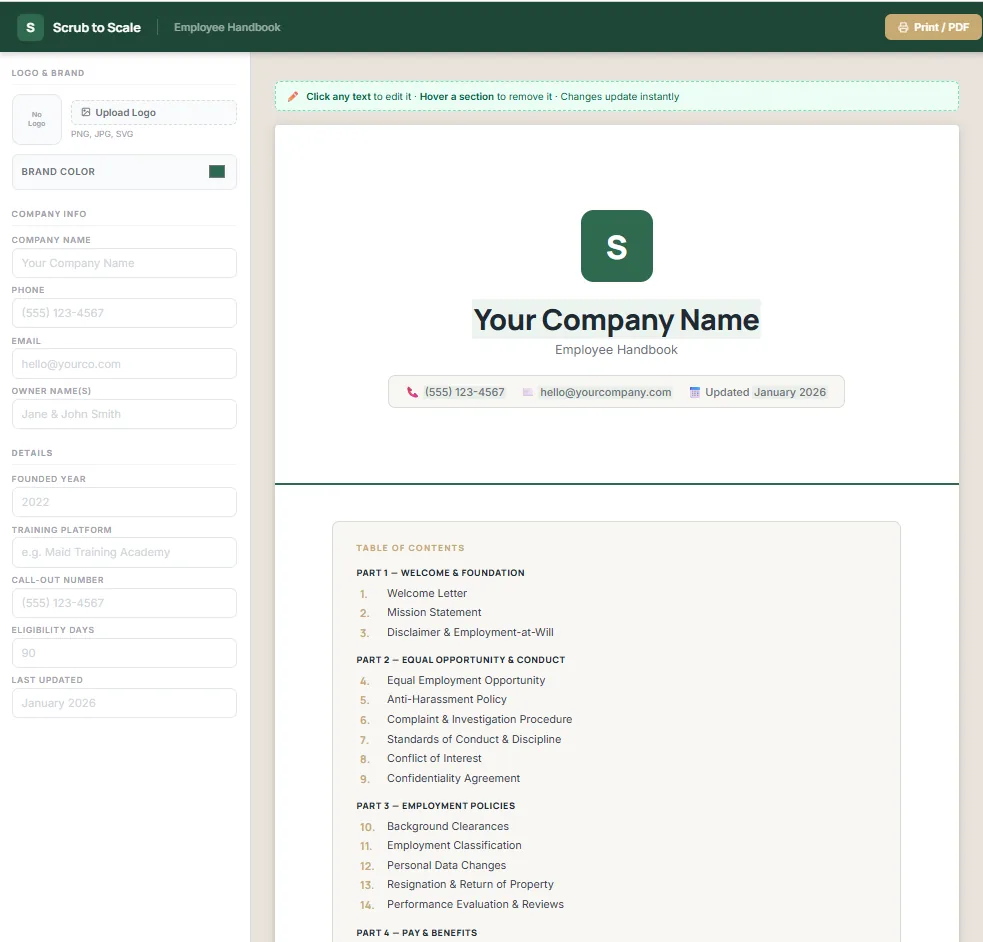
At a minimum, contact info for you and anyone who leads the team, your mission and values, your call-off and uniform and clock-in rules, a quick intro to your scheduling software, office and travel expectations, how supplies and caddies are handled, and your expectations for how employees treat a client's home. That is the table of contents I use, and I walk through each one below.
Do I really need a handbook if I only have one or two cleaners?
Yes, and that is the easiest time to write it. A handbook with two people is a one-page document you can finish in an afternoon. Waiting until you have nine people and a turnover problem means you are writing rules in the middle of a crisis, which is the worst time to do it.
Is an employee handbook a legal document?
It can carry weight, and some sections (classification, pay, time off) touch employment law that varies by state. This is what we do in our business, not legal advice, so have your own employment professional or payroll company review your handbook before you rely on it.
How is a handbook different from my onboarding paperwork?
The paperwork (W4, I9, banking details, signed policies) is what you collect and file for each person. The handbook is the one document that explains how your business actually runs, so a new hire knows the rules before their first day instead of guessing.