The Two-Part System That Keeps My Cleaning Team Showing Up
The most expensive problem in a cleaning business is not a bad quote or a ruined countertop. It is the morning text that says “I am not going to be able to make it in today.” I have gotten that text more times than I can count. Sometimes it is a real emergency. Sometimes it is the third time this month. Either way, a client is expecting a team at their door in two hours, and now I am scrambling.
You cannot run a clean if nobody shows up to do it. So over a few years and a lot of hiring mistakes, I built a system to keep my team reliable. It has two parts, and the whole thing falls apart if you only use one.
Why one half never works
Most owners try to fix attendance with a single lever, and they pick the wrong one for their personality.
The soft owners, and I was one of them, try to fix it with kindness alone. Be a great boss, pay well, be understanding, and surely people will show up. They do not. Kindness with no consequence just teaches your best people that the rules are optional, and your least reliable people that there is no line they can cross.
The tough owners go the other way. All policy, all consequence, zero warmth. That gets people in the door for a while, but it does not keep them. They show up resentful, they do the minimum, and the first better offer they get, they take it. Now you are back to hiring, and hiring is expensive very quickly.
Reliability comes from both at once: a clear line people cannot cross, and a real reason to stay on the right side of it. Accountability plus reward. Here is exactly how I run each half.
Part one: the call-off policy that holds the line
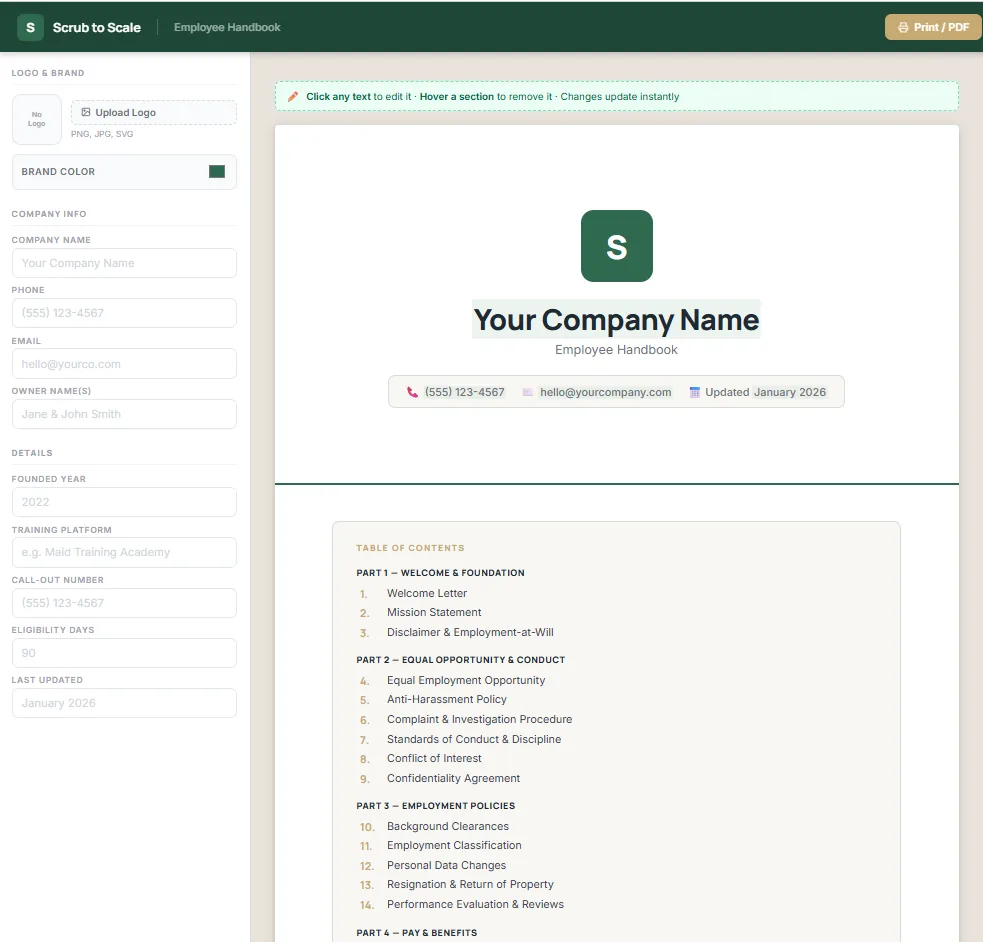
The accountability side lives in my employee handbook, and every single hire signs it on day one before they ever touch a client’s home. That signature matters. It is a lot harder for someone to argue the policy is unfair when their own signature is on it.
My call-off policy spells out three things in plain language: how much notice I expect when someone needs a day (not a text at 6am the morning of, except for a true emergency), the difference between an excused absence and a no-call no-show, and what happens as it stacks up. That last part is the one owners skip, and it is the one that matters. A policy with no consequence written into it is not a policy, it is a suggestion.
I will be honest about where my line is, because a real number is more useful than a vague one. If someone cannot make it in and calls off twenty-seven times in a single month, that is not a scheduling hiccup, that is someone telling you they do not want the job. You cannot accommodate that and stay in business. At that point you are not being mean by letting them go, you are protecting the clients and the coworkers who do show up. I learned this the hard way, back when I was too busy people-pleasing to enforce my own rules. I wrote about that whole mindset shift in why you have to stop people-pleasing.
The key is that the policy is only worth the paper it is on if you actually follow it. The first time you let a clear violation slide because you like the person, you have taught your whole team that the handbook is decorative. Attendance discipline also brushes up against employment law, so this is a good place to say what I always say: this is what we do, and you should have your own employment professional review your handbook before you rely on it. Get the words right once, and it protects you for every hire after.
Part two: the reward that makes reliability worth it
Here is the half that most owners never build, and it is the half that actually keeps people.
Accountability tells your team what happens when they fail. Reward tells them it is worth succeeding. Right now I have nine employees, and every quarter I give the ones who showed up consistently a gift card, somewhere between $50 and $100, scaled by how many days they actually worked. The person who was there every shift gets the top of that range. I also give a small card, around $15, on birthdays. It is not much money. That is the entire point.
Think about what a reliable cleaner is worth to you. They keep your recurring clients happy, they let you take a day off without the whole thing collapsing, and they do not cost you a single dollar of retraining. Now compare that to what a bad hire costs: the paid training you sink in, the client who quietly cancels when a stranger shows up instead of their usual person, the momentum you lose. A $50 gift card is nothing next to that. It is one of the cheapest, highest-return things I spend money on all year.
The reason it works is that it is tied to the exact behavior I want. It is not a bonus everyone gets no matter what, which just becomes an expectation people resent losing. It is a reward for showing up, which is the whole thing I am trying to protect. Pair that with the call-off policy and the two halves reinforce each other: there is a cost to being unreliable and a genuine payoff for being reliable.
The version that costs you nothing
If money is tight and you cannot do gift cards yet, do not skip the reward side entirely. The reward does not have to be cash.
We keep a whiteboard in the office and update it every week with reminders, birthdays, little polls, sometimes a dumb quote. It sounds like nothing. It is not nothing. People want to feel seen, and something as small as their birthday written on a board where the whole team can see it does more for retention than owners expect. Add a coffee run on a random Tuesday, a real thank-you note, remembering that someone’s kid had a recital. Retention is not one big gesture, it is a hundred small ones, and most of them are free. The true cost of turnover makes even the paid version look cheap, but you can start with the free version today.
Build the system before you need it
The mistake I made early was treating every call-off as a one-off crisis to handle in the moment, instead of a system to build once. If you are still hiring your first people, set this up now while it is simple, not after you have ten cleaners and a reliability problem. Get the paperwork right the first time (I walk through the full onboarding folder in the new-hire paperwork system), and get your pricing high enough that paying and rewarding people well actually fits your margins. Your labor should land around 35 to 45 percent of revenue in residential, and if paying fairly blows past that, the fix is your prices, not your people. You can see what profitable prices look like by home size on our cost pages.
A reliable team is not luck and it is not personality. It is a system: a clear line and a real reward, written down, signed, and actually followed. The exact call-off policy and handbook my team signs are in my hiring bundle, set to your numbers and your logo, so you can have yours signed before the next 6am text. Spend your energy on your people, which is where it belongs. Scrub smarter, scale harder.
Frequently asked questions
How do I get my cleaning employees to stop calling off?
You need two things working together, not one. First, a written call-off policy in your handbook that spells out how much notice you require, what counts as an excused absence, and what happens when someone crosses the line. That is the accountability side. Second, a reward for the people who do show up consistently, like a periodic gift card scaled by how reliable they were. Accountability without reward feels like punishment, and reward without accountability gets taken for granted. You need both.
What should a cleaning business call-off policy include?
At minimum, how much advance notice you expect for a day off, the difference between an excused absence and a no-call no-show, and the consequences that build up if it keeps happening. Put it in writing in your employee handbook, have every hire sign it on day one, and then actually follow it. A policy you do not enforce is worse than no policy, because it teaches your team the rules are optional. Have an employment professional review your handbook before you rely on it, since attendance discipline touches employment law.
Are gift cards a good employee retention tool for a small cleaning business?
Yes, and they are one of the cheapest tools you have. I give reliable cleaners a $50 to $100 gift card each quarter, scaled by how many days they worked, plus a small card on their birthday. That is a tiny amount next to what it costs to lose a good cleaner and train a replacement from scratch. A gift card is not a bonus you owe, it is a signal that showing up gets noticed.
How much does it cost to replace a cleaner who quits?
More than the gift cards ever will. Between the paid training you already sank into the person who left, recruiting and ramping a replacement, and the clients who drift when the service gets inconsistent, a single departure quietly costs hundreds of dollars and weeks of momentum. That math is exactly why paying to keep your reliable people is cheaper than replacing your unreliable ones.