The New-Hire Paperwork System Every Cleaning Business Needs
I was alphabetizing employee folders on camera the other day, one labeled folder per person, and it hit me how far this small system has carried me. Signed W4 inside, signed call-off policy, banking information, the agreement they sign about our clients, all of it in one place. It is safe to say I have been through a lot of trauma, because hiring is hard and employees are harder. The paperwork is the part almost every new owner skips, and it is the part they end up regretting.
So let me walk you through the exact onboarding file system we use, why it matters more than it sounds, and how to set it up before you ever make your first hire.
A quick and honest note first: I am not your accountant or your attorney, and employment paperwork rules vary by state. This is what we do and what we have learned. Confirm the specifics with a payroll company or a professional before you put anything in front of a new hire to sign.
The paperwork is not busywork, it is protection
When you bring someone on as a real W2 employee, you are taking on a lot of responsibility. You are running payroll, withholding taxes, carrying workers comp, and sending a person into a client’s home with a key or a code. Every one of those things has a piece of paper behind it, and if you cannot find that paper when you need it, you have a problem.
I learned this the way most people do, by doing it badly first. Early on my documents lived in a drawer, in my email, in a couple of different apps, wherever they landed. Then I would go looking for someone’s signed policy months later and could not find it. Once you have a team, that disorganization is not a small annoyance, it is a real risk. If W2 versus 1099 is still a question mark for you, start with W2 vs 1099 for Cleaning Employees, because that decision changes what paperwork you even need.
What goes in every employee’s folder
Here is what we keep for each person, in their own labeled folder.
The tax and payroll forms. A signed W4 and I9, and their banking information for direct deposit. If you use a payroll company, they will handle most of this and store the digital copy, which is exactly why a good one is worth the monthly cost. I still keep my own physical copy so nothing depends on me logging into one more system.
A signed call-off policy. This is the one owners forget, and it is the one that saves you. Your policy should spell out how much notice you expect, how someone calls off, and what happens when it becomes a pattern. Get it signed. When you have to have a hard conversation later, it matters that they agreed to the rules in writing on day one.
The employee handbook. Even a simple one. Mine grew one painful lesson at a time. An employee showed up smelling like something from the night before, a client noticed, and it went straight into the handbook. Someone took a loud personal call while a client was working from home in the next room, and that went in too. Every awkward situation becomes a line in the handbook so I never have to relitigate it from scratch.
An agreement around your clients. Some owners use a non-compete, others a lighter non-solicitation agreement, the goal being that someone you trained does not walk out the door with the clients you spent years earning. Be careful here: enforceability varies a lot by state, and some states limit these heavily. This is the piece I would genuinely run past an employment attorney before asking anyone to sign it.
None of this is exciting. All of it is the difference between a business that runs on rules and one that runs on your memory. And your memory, with 100-plus clients and a team, is not a filing system.
The blank-copy folder that makes hiring repeatable
Here is the small trick that changed onboarding for me. Right next to the employee folders, I keep one more folder full of blank copies of every single form. Blank W4, blank call-off policy, blank handbook acknowledgment, all of it.
So when I hire someone new, I am not hunting for a template or rebuilding a document at 9pm. I pull one of each from the blank folder, and the new hire is ready to go. Build the system once, keep the blanks stocked, and every future hire becomes routine instead of a scramble. That is the whole point of a system: you solve the problem one time and never solve it again.
Do the background check before the first home
This belongs in the onboarding stack too, before that first clean, not after. Your people walk into homes, often when nobody is there, so screening protects your clients and protects you. We use Checkr because results come back in minutes and candidates can finish it from their phone, which means they actually finish it. (Checkr is an affiliate partner, so we may earn a commission if you sign up.) Once it clears, they move into training. If you have not built out your training flow yet, here is how I train a new cleaner so they actually stay.
The whiteboard that keeps the team running
Paperwork gets someone hired correctly. Something has to keep them engaged after that, and for us a lot of that job is done by a whiteboard.
We update ours every week with reminders, polls, upcoming birthdays, and sometimes a fun quote. It sounds almost too simple to matter. It matters. Something as small as a whiteboard keeps people organized, keeps them acknowledged, and keeps them feeling like part of something, which is most of what keeps good employees around. Retention is not only about pay, though pay matters, it is about all the small signals that someone notices you. And retention is where the real money is, because every time you lose a good person you pay for it twice, which is the whole argument in the real cost of employee turnover.
Set it up before you need it
The owners who struggle with hiring are almost never struggling with the actual person. They are struggling because nothing was built ahead of time, so every hire feels like starting over. Build the folder system, stock the blank copies, write the call-off policy, and get the handbook started before you make your first offer.
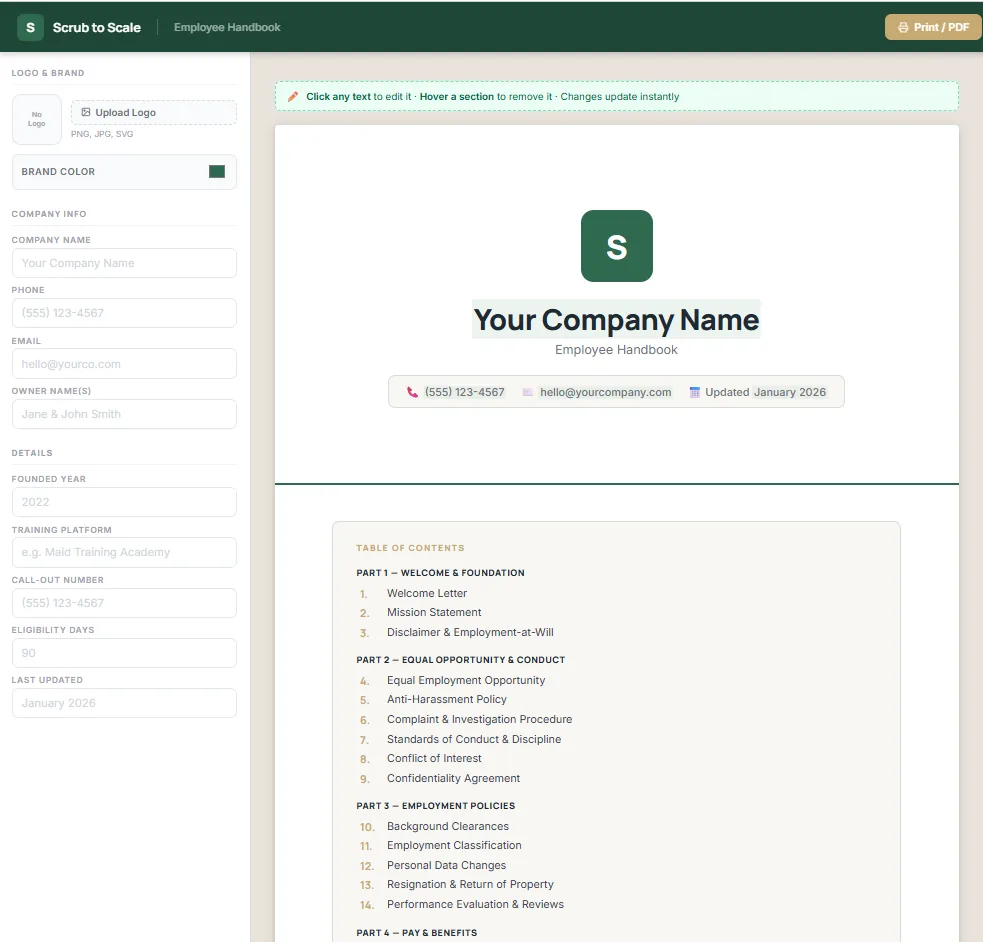
You can run all of this out of a file box and a whiteboard, and for a long time you should. What goes in the folder is the part I can hand you: the handbook, the call-off policy, the contractor agreement, and the onboarding checklist and emergency contact form my team fills out on day one are all in my hiring bundle, with your logo on them. Get the boring paperwork right early, and you free yourself up for the part that actually grows the business. Happy learning and happy growing.
Frequently asked questions
What paperwork do I need for a new cleaning employee?
At a minimum, plan on a signed W4 and I9, their banking details for payroll, a signed copy of your call-off policy, your employee handbook, and any agreement you use around clients and confidentiality. Rules vary by state, so confirm the exact list with your accountant or payroll company before your first hire.
How should I organize employee onboarding documents?
Keep one labeled folder per employee with every signed form inside, and store them together in a single file box instead of scattered across a drawer or your email. We also keep a separate folder of blank copies of every form, so the next hire is ready to go without hunting for anything.
Do I need a non-compete for cleaning employees?
Some owners use a non-compete or a simpler non-solicitation agreement so employees do not walk off with clients, but enforceability varies a lot by state and some states limit them heavily. This is exactly the kind of thing to run past an employment attorney before you ask anyone to sign it.
When should I set up my hiring paperwork?
Before you hire, not during. Trying to assemble a W4, a handbook, and a call-off policy on someone's first day is how forms get skipped and mistakes happen. Build the system once, keep blank copies on hand, and every future hire becomes routine.