SOPs for Cleaning Businesses: What to Document and Where to Start
Here is a simple test for whether your cleaning business can grow: if you disappeared for two weeks, could anyone else run it? If the answer is no, it is because all the how-to lives in your head. Standard operating procedures, or SOPs, are how you get it out of your head and into your business. This is squarely my side of what Maigan and I do, so let me make it practical.
What an SOP actually is
An SOP is just a documented, repeatable way to do a task. How you perform a deep clean. How you onboard a new hire. How you handle an upset customer. Written down, step by step, so anyone on your team can do it your way and get a consistent result.
That word, consistent, is the whole point. A client should get the same quality whether it is you, your newest hire, or your general manager doing the work. SOPs are what make that possible.
Why they matter more than they sound like they do
Maigan made the classic mistake early on. She kept how she wanted things done in her head instead of on paper. So when she wanted her general manager to take over scheduling and other areas, the onboarding was rocky, because there was nowhere for her GM to learn from. Once she documented those processes, her GM had somewhere to go for answers instead of interrupting her with every small question.
That is the real payoff. SOPs give you faster training, more consistency, better quality control, and the ability to actually hand things off. They are the difference between a business that depends on you and one that can run without you.
Which ones to write first
Do not try to boil the ocean. Start with the ones that protect quality and safety:
- Service checklists for standard, deep, and move-out cleans. These are the backbone, they keep every clean consistent and tell both your team and your clients exactly what is included. If you have not defined these, start with Standard vs Deep vs Move-Out Cleaning.
- A safety procedure for what to do if someone is hurt on a job. You do not want to figure that out in the middle of an emergency.
From there, the high-value ones to add next: employee onboarding, your interview process, scheduling, payroll, and how to handle a complaint. We cover the people side in How to Train a New Cleaner.
Keep them simple
An SOP does not need to be a polished manual. A checklist or a short bulleted list of steps is plenty. For cleaning a bathroom, that might be: remove the mats, dust, then work top to bottom, and so on. The test is whether someone can follow it and get the result you want, not whether it looks impressive.
Build the library over time
The biggest mistake is feeling like you have to document everything at once. You do not. Trying to do all of them is exactly how people get overwhelmed and write none. It is far better to have a few really good SOPs than a perfect set that does not exist.
So write a couple, use them, and add more whenever you have time, often on an admin day. And keep them updated, because your business changes. An SOP is not a one-and-done document. When you find a better way to do something, or a new situation comes up, update it. That climb is worth it, because once these are in place, handing off work and scaling gets dramatically easier.
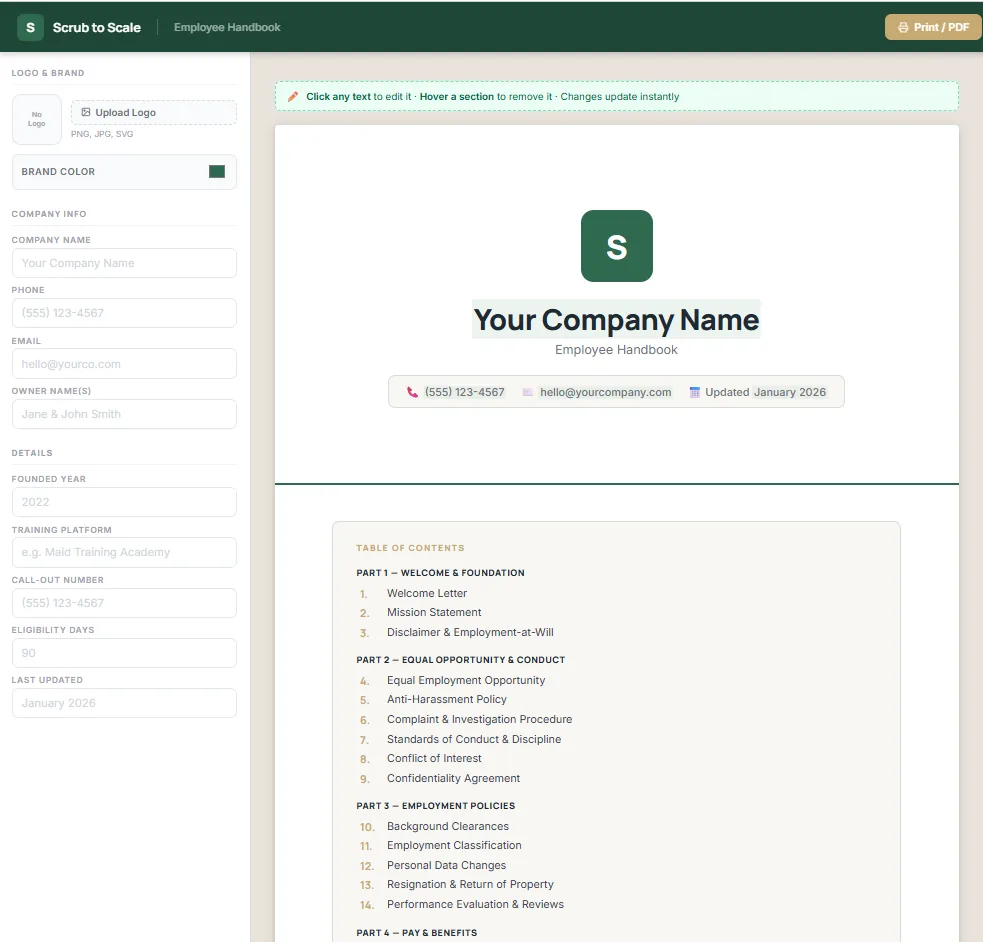
If you want a head start on the documentation, Maigan’s Hiring Bundle is the written version of how her team runs: the handbook, the call-off policy, and the onboarding checklist, with an editor that puts your logo and your details on every page. Start with those, then add your own SOPs one at a time. Scrub smarter, scale harder.
Frequently asked questions
What is an SOP for a cleaning business?
A standard operating procedure is a documented, repeatable way to perform a task in your business, like how to do a deep clean, onboard an employee, or handle an upset customer. It lets anyone on your team do the task your way, consistently.
Which SOPs should I create first?
Start with your service checklists for standard, deep, and move-out cleans, then a safety procedure for if someone is hurt on a job. After that, add onboarding, scheduling, payroll, and handling complaints.
How do I write an SOP?
Keep it simple. A checklist or a short bulleted list of steps is enough. It does not need to be a polished manual. The goal is that someone can follow it and get the result you want.
Do I have to write all my SOPs at once?
No. Trying to document everything at once is how people get overwhelmed and do none of it. Write a few good ones, then build your library over time and keep them updated as your business changes.